Broken Umbrella Planter: A Hanging Flower DIY
Gardens Glow Editorial · 2026-07-26
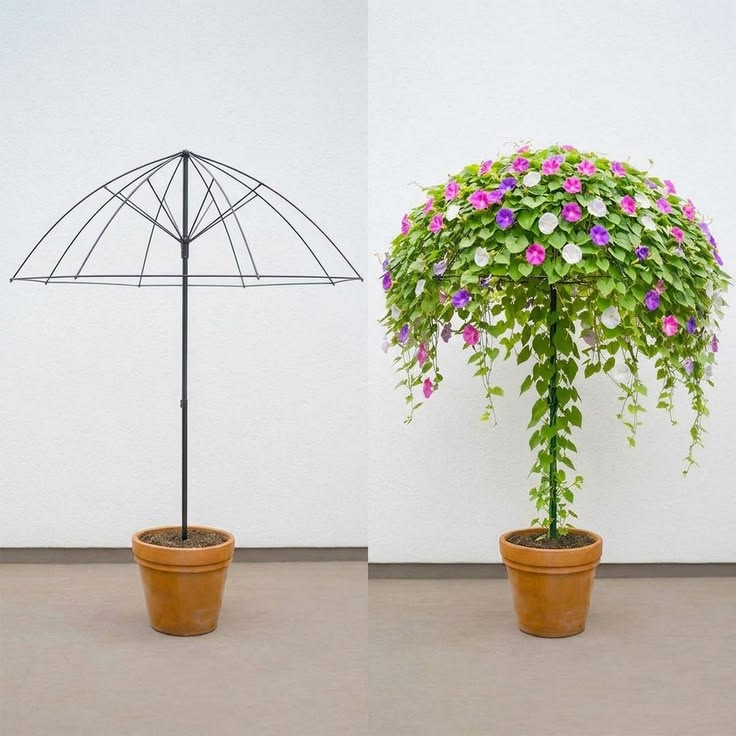
Two ways to turn a broken umbrella into a flower display that actually holds up: a hanging flower parasol and a shallow umbrella bowl planter. Plants and care.
A broken umbrella makes a charming garden feature, but only if you respect one limit: umbrella ribs are thin, and wet potting mix weighs close to a kilogram per litre. Fill an open canopy with soil and the ribs fold within a week. The two builds below work with that limit instead of against it. The first hangs light pots of trailing flowers from an open umbrella; the second turns the canopy into a shallow, lined bowl for small, tough plants.
Build 1: The flower parasol (easiest)
The umbrella stays the right way up, open like a sunshade, and trailing flowers hang from the tips of its ribs. It looks like a parasol dripping with flowers.
You'll need
- A large umbrella with a sound frame; torn fabric doesn't matter.
- A parasol base, or a bucket filled with sand, gravel or concrete, to hold the shaft upright.
- 6–8 small, lightweight hanging pots or coir-lined mini baskets, 12–15 cm (5–6 in) across.
- S-hooks or galvanised wire, and cable ties.
- Peat-free potting mix with some water-retaining granules.
- Trailing plants (see the list below).
Steps
- Strip or keep the fabric. Remove torn fabric completely for a skeleton look, or leave intact fabric on for a striped canopy.
- Strengthen the frame. Wrap wire around any loose rib joints and secure the open umbrella with a cable tie at the runner so it can't close.
- Set the shaft firmly in a parasol base or a heavy bucket. The display catches the wind, so it must not wobble.
- Plant the small pots and water them well before hanging.
- Hang one pot from each rib tip with an S-hook or wire loop. Space them evenly so the weight is balanced, and keep each pot light, no more than about 1–1.5 kg (2–3 lb) when wet.
Alternative: run strings from the rib tips down to pegs in the ground and grow a light climber such as nasturtiums, sweet peas or morning glory up them. By mid-summer you'll have a living, flower-covered tent.
Build 2: The umbrella bowl planter
Here the umbrella is turned upside down so the canopy forms a bowl, with the shaft pushed into the ground or a weighted bucket. The trick is to keep the soil shallow and light.
Steps
- Reinforce the ribs. Tie a ring of stiff wire around the ribs about two-thirds of the way out, fixing it to each rib with cable ties. This stops the ribs spreading under weight.
- Line the bowl with a coir hanging-basket liner or landscape fabric resting on the ribs and fabric. Make several small slits at the lowest points for drainage.
- Use a light mix: two parts peat-free potting mix to one part perlite. Fill only 8–10 cm (3–4 in) deep, which works out at roughly 5 litres for a medium umbrella.
- Plant shallow-rooted, drought-tolerant plants: sedums, sempervivums and other succulents are ideal, because they cope with shallow soil and don't need constant watering.
- Fix the shaft firmly in the ground or a bucket of concrete. Check after the first heavy rain that the bowl still sits level.
Best plants for umbrella displays
| Build | Plants | Why |
|---|---|---|
| Flower parasol (hanging pots) | Trailing petunias, calibrachoa, trailing lobelia, ivy-leaved pelargoniums, bacopa, nasturtiums | Long flowering, trail gracefully, light |
| Umbrella bowl | Sedums, sempervivums, small echeverias (summer only in cold areas), creeping thyme | Cope with shallow, dry soil; low weight |
| Living parasol (strings) | Nasturtiums, sweet peas, morning glory, black-eyed Susan vine | Fast annual climbers |
For more easy choices, see our list of low-maintenance flowers.
Care
- Watering: small hanging pots dry out quickly. In summer, check them daily and water whenever the surface is dry; in a heatwave, twice a day (RHS). Succulent bowls need water only when the mix is completely dry.
- Feeding: petunias and calibrachoa are hungry. Give a liquid feed every week from early summer. Succulents need little or none.
- Deadheading: pinch off faded flowers every few days to keep the display going.
- Wind: take the display down or move it to shelter if strong winds are forecast. An umbrella is designed to catch air.
- Winter: remove the plants, dry the frame and store it indoors to slow rust.
Safety checklist
- Keep rib tips above head height or away from paths; they're sharp at eye level.
- Make sure the base can't tip over, especially near children and pets.
- Check the frame for rust each spring before reusing it.
Similar projects
If you like turning everyday objects into planters, try our hanging strawberry planter video, a vertical herb garden, or the other upcycling ideas in our budget gardening guide.
Frequently asked questions
Can I fill an open umbrella with soil?
Not much. Umbrella ribs can't carry a full canopy of wet soil. Keep it to a shallow, lined layer of light mix, or hang small pots from the ribs instead.
What flowers look best hanging from an umbrella?
Trailing petunias, calibrachoa and trailing lobelia give the fullest, longest-lasting cascade.
How long will an umbrella planter last?
The frame usually lasts a few seasons outdoors if you store it indoors over winter and treat any rust.
More ideas in our DIY projects.