How to Grow Carrots in Containers and Pots
Gardens Glow Editorial · 2026-07-29
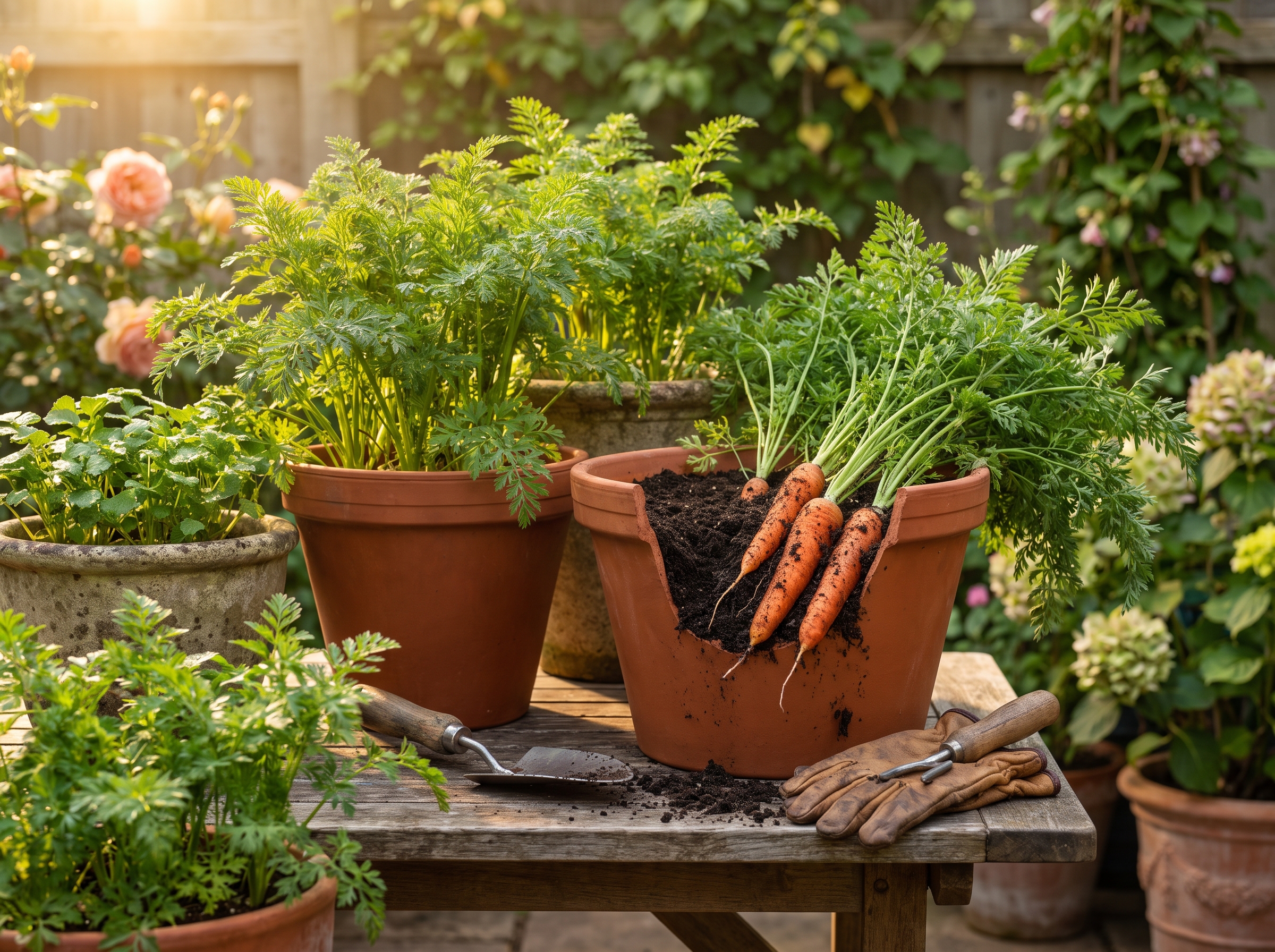
Carrots grow well in pots with the right variety and depth. Container sizes, sowing, thinning, watering and carrot fly tips for straight, sweet roots.
Carrots grow surprisingly well in containers, and pots solve two of their biggest problems in the ground: stony, heavy soil that makes them fork, and carrot fly. The keys are matching the variety to your container's depth, sowing directly where they'll grow, and keeping the soil evenly moist. Here's exactly how to do it.
Match the variety to your container's depth
The single most important decision is pairing the carrot type with a container deep enough for it. As a rule, the pot should be at least 5–8 cm (2–3 in) deeper than the length of the mature root.
| Carrot type | Example varieties | Root length | Minimum pot depth |
|---|---|---|---|
| Round | 'Paris Market', 'Atlas' | 3–5 cm (1–2 in) | 15–20 cm (6–8 in) |
| Short / Chantenay | 'Chantenay Red Cored', 'Danvers Half Long' | 10–15 cm (4–6 in) | 25–30 cm (10–12 in) |
| Nantes | 'Early Nantes', 'Nantes 2' | 15–18 cm (6–7 in) | 30–35 cm (12–14 in) |
| Long (Imperator, 'Autumn King') | 'Autumn King' | 20 cm+ (8 in+) | 45 cm+ (18 in+); best left for the ground |
For a first container crop, Nantes or Chantenay types are the best balance of size, sweetness and reliability. Round types are ideal for window boxes and shallow troughs.
Choose a container
- Grow bags and fabric pots drain well and stay cool, the same reasons they work for growing potatoes in grow bags.
- Buckets, deep troughs and large plastic pots are fine, as long as they have plenty of drainage holes.
- Width matters too. A 30 cm (12 in) wide pot holds around 20–25 carrots at final spacing; a 60 cm (24 in) trough holds three times as many.
Fill it with the right mix
Carrots need loose, stone-free soil they can push straight down through. Use a multipurpose potting mix and blend in about a quarter sharp sand or perlite to keep it open. Avoid rich mixes, fresh manure or high-nitrogen fertilizer: excess nitrogen gives you leafy tops, forked roots and hairy carrots. Fill the container to 2–3 cm (an inch) below the rim and firm it lightly. For more on improving garden soil, see our soil improvement guide.
Sow directly, never transplant
Carrots hate root disturbance. Transplanted seedlings tend to fork or twist, so always sow seed where the carrots will grow (RHS).
- Timing: sow from early spring, once the soil has warmed above about 7°C (45°F), until mid-summer. In the UK the main season runs from April to early July. Containers warm up faster than open ground, so you can often start a couple of weeks earlier.
- Sow thinly: carrot seed is tiny. Mix it with a little dry sand and sprinkle it over the surface, aiming for a seed every 1–2 cm.
- Cover lightly: about 1 cm (½ in) of potting mix, then water gently with a fine rose so the seed doesn't wash to the edges.
- Keep the surface damp until seedlings appear, which takes one to three weeks. A sheet of damp cardboard or hessian over the pot helps; check it daily and remove it as soon as you see green.
- Sow again every three weeks for a steady supply rather than one glut.
When to sow where you live
Carrots like cool to mild weather. They germinate slowly in cold soil, and in very hot weather germination drops off and the roots can turn pale and less sweet.
- Cool and temperate climates (UK, northern Europe, northern US): sow from early spring to mid-summer, every three weeks. Late sowings give carrots for autumn.
- Warm and hot climates (southern US, the Mediterranean, subtropical regions): avoid the peak of summer. Sow in late summer to autumn and again in late winter, so the crop grows through the cooler months.
- Containers help either way: you can move pots into light shade during a heatwave or into the warmest corner in early spring.
A trick for slow seed: radish markers
Carrot seed can take up to three weeks to come up, which makes it easy to forget where you sowed and to let the surface dry out. Mix a few radish seeds in with the carrot seed. Radishes sprout in days, show you exactly where the carrots are, and break any crust on the soil surface so the carrot seedlings push through more easily. Pull the radishes after four to five weeks, before the carrots need the space, and eat them.
Thin seedlings (and dodge carrot fly)
When seedlings are about 5 cm (2 in) tall, thin them to roughly 2–3 cm (1 in) apart, and a few weeks later to a final 5 cm (2 in). Crowded carrots stay tiny. The thinnings are edible as micro-carrots.
Thinning releases the carrot scent that attracts carrot fly, a pest whose larvae tunnel into the roots. Thin on a still evening, remove every thinning from the pot, and water afterwards to settle the soil.
Keep carrot fly out
Carrot fly flies low, close to the ground. The RHS suggests a barrier of fine insect mesh at least 60 cm (2 ft) high around crops (RHS). Containers give you an easy version of that: raise the pots on a table, bench or balcony ledge so the crop sits above the flies' flight height. Resistant varieties such as 'Flyaway' and 'Resistafly' help further, though they reduce damage rather than prevent it completely.
Watering: steady beats generous
Uneven watering is the main cause of split carrots: a dry spell followed by a soaking makes the root swell faster than its skin can stretch. Containers dry out faster than beds, so check them daily in warm weather and water when the top 2–3 cm feels dry, soaking the whole depth of the pot each time. For a general guide, see how often to water vegetable plants.
Sun and feeding
Give carrots at least six hours of sun; they'll tolerate a little afternoon shade, which helps in hot climates. Fresh potting mix usually contains all the nutrients a carrot crop needs. If the foliage looks pale after six weeks, use a liquid feed that's low in nitrogen and high in potassium (a tomato feed works) at half strength every two to three weeks. Our guide to homemade fertilizers has gentle options.
When and how to harvest
- Baby carrots: from about six to eight weeks after sowing.
- Full-size carrots: usually ten to twelve weeks or more, depending on variety. Check the seed packet for days to maturity.
- Check before you pull: brush the soil away from the top of a root. If the shoulder is the width you want, it's ready.
- Water first: moist soil lets carrots slide out without snapping.
- Before hard frost: containers freeze through faster than the ground, so harvest everything before a hard frost, or move pots into a sheltered spot.
Twist off the leaves before storing; they draw moisture out of the root. Unwashed carrots keep for weeks in the fridge.
Troubleshooting
- Forked or twisted roots: stones, compacted mix, transplanting, or too much nitrogen.
- Split roots: irregular watering.
- Green tops (shoulders): the root was exposed to light. Cover shoulders with a little extra potting mix as they grow.
- Hairy roots: too much nitrogen, or the roots were stressed by drought.
- Poor germination: the surface dried out before the seed sprouted, or it was sown too deep.
- Lots of leaf, tiny roots: overcrowding, too much shade or too much fertilizer.
A simple balcony plan
Three containers, each sown three weeks apart from mid-spring, give a steady supply of carrots through summer and into autumn. Pair them with a pot of fast salad leaves and you have a small but productive balcony veg garden. Looking for what else to sow now? See the best vegetables to plant in spring, or build a raised garden bed for bigger crops.
Frequently asked questions
How deep does a container need to be for carrots?
At least 15–20 cm (6–8 in) for round varieties and 30 cm (12 in) for Nantes types. Allow 5–8 cm more than the expected root length.
How many carrots can I grow in one pot?
At a final spacing of about 5 cm (2 in), a 30 cm (12 in) wide pot holds roughly 20–25 carrots.
Can carrots grow in partial shade?
Yes, with four to six hours of sun they'll still crop, but the roots will be smaller and slower to mature.
Can I grow carrots indoors?
Round varieties can work in a very bright spot or under a grow light, but outdoor containers produce far better crops.
Why are my carrots so small?
Usually overcrowding (thin more), not enough sun, or harvesting too early. Too much nitrogen can also push growth into the leaves.
Find more crops in our vegetable growing guides.